
The UNA Resources, Local Updates Blog
Stop trying to find information all over the web. Start below with a simple access to read the blog’s United Nurse of Alberta (UNA) resources, UNA Local 115 updates and our newsletter so you can be informed!
Ability Management and Sick Leave
Ability Management and Sick Leave
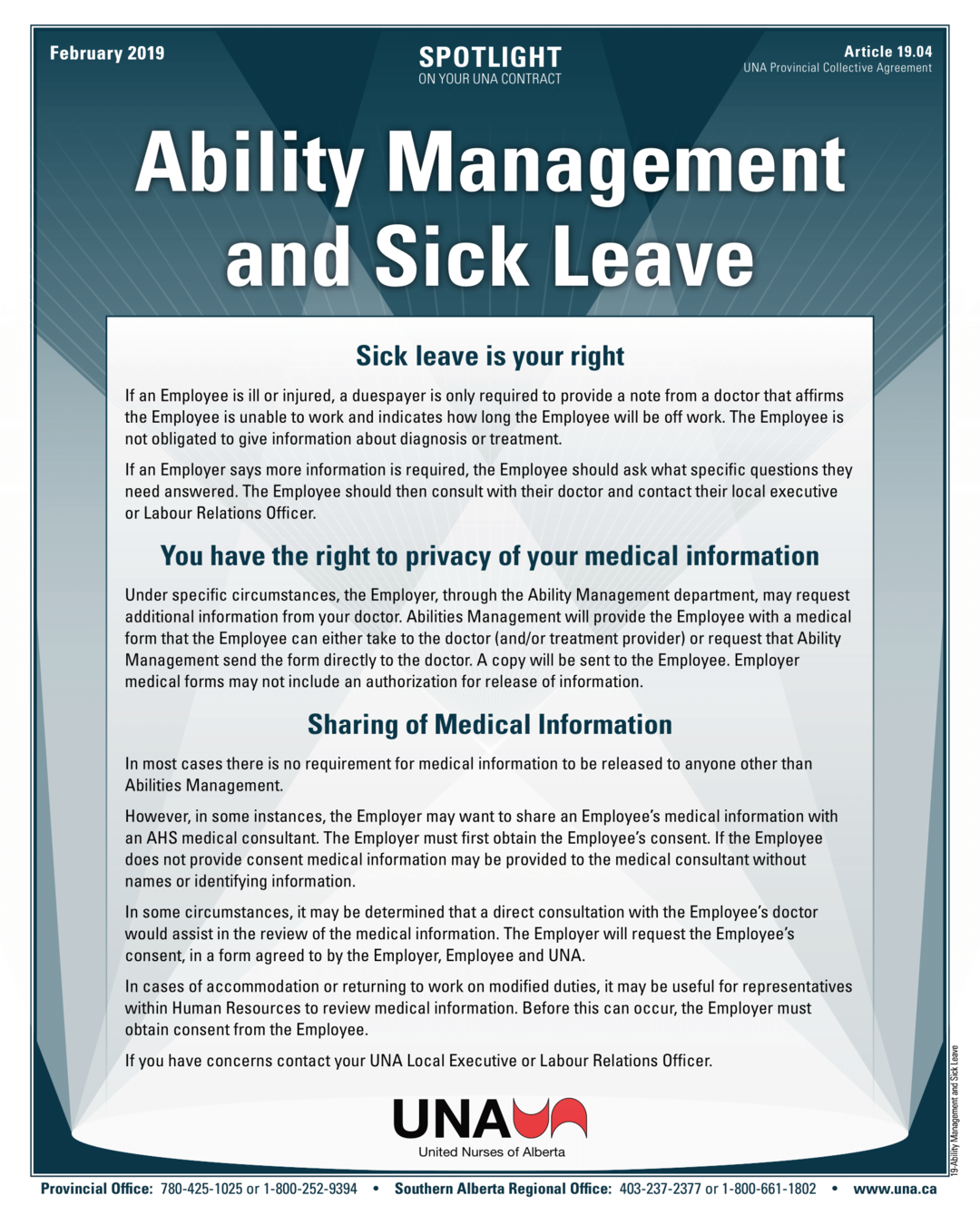
Sick leave is your right If an Employee is ill or injured, a duespayer is only required to provide a note from a doctor that affirms the Employee is unable to work and indicates how long the Employee will be off work. The Employee is not obligated to give information about diagnosis or treatment. If an Employer says more information is required, the Employee should ask what specific questions they need answered. The Employee should then consult with their doctor and contact their local executive or Labour Relations Officer. You have the right to privacy of your medical information Under specific circumstances, the Employer, through the Ability Management department, may request additional information from your doctor. Abilities Management will provide the Employee with a medical form that the Employee can either take to the doctor (and/or treatment provider) or request that Ability Management send the form directly to the doctor. A copy will be sent to the Employee. Employer medical forms may not include an authorization for release of information. Sharing of Medical Information In most cases there is no requirement for medical information to be released to anyone other than Abilities Management. However, in some instances, the Employer may want to share an Employee’s medical information with an AHS medical consultant. The Employer must first obtain the Employee’s consent. If the Employee does not provide consent medical information may be provided to the medical consultant without names or identifying information. In some circumstances, it may be determined that a direct consultation with the Employee’s doctor would assist in the review of the medical information. The Employer will request the Employee’s consent, in a form agreed to by the Employer, Employee and UNA. In cases of accommodation or returning to work on modified duties, it may be useful for representatives within Human Resources to review medical information. Before this can occur, the Employer must obtain consent from the Employee. If you have concerns contact your UNA Local Executive or Labour Relations Officer.
Employer cannot unilaterally schedule vacations
Employer cannot unilaterally schedule vacations
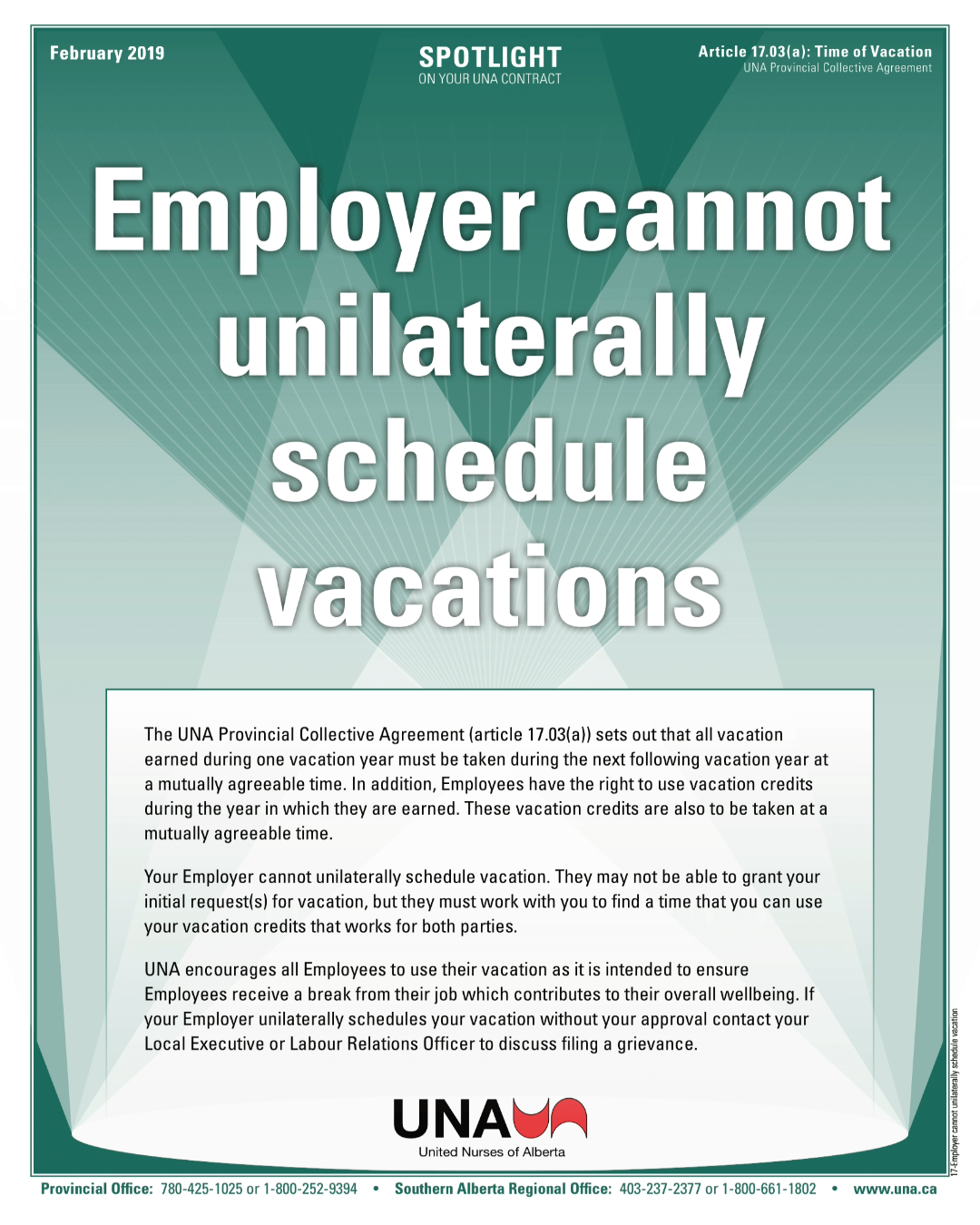
The UNA Provincial Collective Agreement (article 17.03(a)) sets out that all vacation earned during one vacation year must be taken during the next following vacation year at a mutually agreeable time. In addition, Employees have the right to use vacation credits during the year in which they are earned. These vacation credits are also to be taken at a mutually agreeable time. Your Employer cannot unilaterally schedule vacation. They may not be able to grant your initial request(s) for vacation, but they must work with you to find a time that you can use your vacation credits that works for both parties. UNA encourages all Employees to use their vacation as it is intended to ensure Employees receive a break from their job which contributes to their overall wellbeing. If your Employer unilaterally schedules your vacation without your approval contact your Local Executive or Labour Relations Officer to discuss filing a grievance.

Casual Employees eligible for overtime when they work in excess 147.25 hours in a four week period
Casual Employees eligible for overtime when they work in excess 147.25 hours in a four-week period


Voting in Municipal Elections
Voting in Municipal Elections
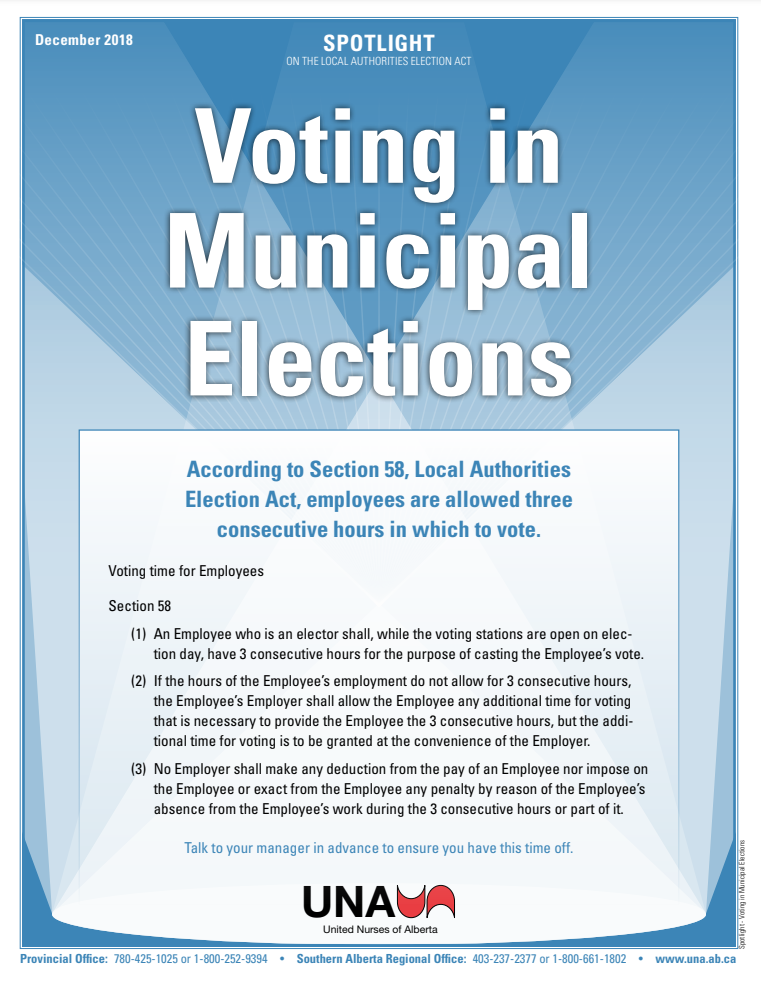
According to Section 58, Local Authorities Election Act, employees are allowed three consecutive hours in which to vote. Voting time for Employees Section 58 (1) An Employee who is an elector shall, while the voting stations are open on election day, have 3 consecutive hours for the purpose of casting the Employee’s vote. (2) If the hours of the Employee’s employment do not allow for 3 consecutive hours, the Employee’s Employer shall allow the Employee any additional time for voting that is necessary to provide the Employee the 3 consecutive hours, but the additional time for voting is to be granted at the convenience of the Employer. (3) No Employer shall make any deduction from the pay of an Employee nor impose on the Employee or exact from the Employee any penalty by reason of the Employee’s absence from the Employee’s work during the 3 consecutive hours or part of it. Talk to your manager in advance to ensure you have this time off.

Casual Employees not required to work a minimum number of shifts
Casual Employees not required to work a minimum number of shifts
An Employer cannot impose the requirement that casual Employees must be available to work a minimum number of shifts, in order to remain on the Casual List. Under the UNA Provincial Collective Agreement there is no provision for requiring Casuals to work a certain number of shifts. Article 30.03 a) i) of the Agreement states: “No Casual Employee shall be scheduled except with the Employee’s consent.” Please note, however, that Casual Employees must keep updated on certifications and communications in the area in which they work. Contact your UNA local executive or your Labour Relations Officer if any Employer is attempting to require a casual employee to work any shift
Part-time Employees working on scheduled days of rest
Part-time Employees working on scheduled days of rest
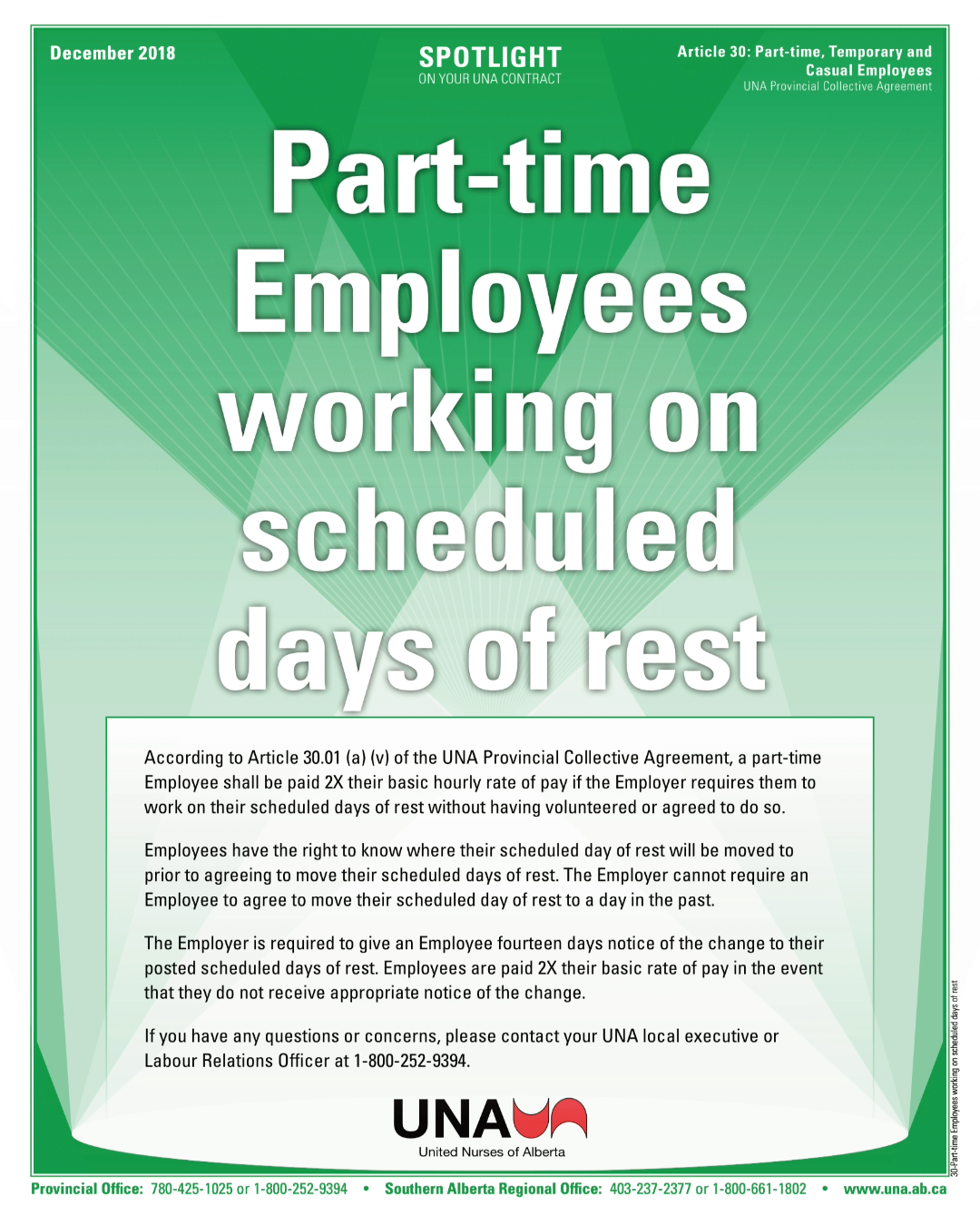
According to Article 30.01 (a) (v) of the UNA Provincial Collective Agreement, a part-time Employee shall be paid 2X their basic hourly rate of pay if the Employer requires them to work on their scheduled days of rest without having volunteered or agreed to do so. Employees have the right to know where their scheduled day of rest will be moved to prior to agreeing to move their scheduled days of rest. The Employer cannot require an Employee to agree to move their scheduled day of rest to a day in the past. The Employer is required to give an Employee fourteen days notice of the change to their posted scheduled days of rest. Employees are paid 2X their basic rate of pay in the event that they do not receive appropriate notice of the change. If you have any questions or concerns, please contact your UNA local executive or Labour Relations Officer at 1-800-252-9394.

Appealing denied drug benefit claims
Appealing denied drug benefit claims
The UNA Provincial Collective Agreement ensures coverage for all prescribed medication. Article 21.01(a)(ii) of the collective agreement states: (a) (ii) 80% direct payment provision for all medication prescribed by a qualified practitioner. Subject to continuation of Joint Appeal Panel criteria that medication must be: (A) prescribed by a physician, dentist, pharmacist or nurse practitioner to correct or treat a medical condition: that is (B) based on a diagnosis made by a physician, dentist or nurse practitioner; and (C) which is required to be consumed (orally, by injection, absorbed or inhaled); and is (D) dispensed by a pharmacist. Employees who have had a prescription claim denied should contact their UNA local executive or Labour Relations Officer.

Protect your rights after an extended absence
Protect your rights after an extended absence
United Nurses of Alberta must be consulted in all cases of return to work and duty to accommodate Employees returning to work after an extended absence have the right to Union representation. For Employees who have medical restrictions on the work they can do and are being accommodated in a position that matches their abilities, UNA must be involved to ensure fair and safe treatment. UNA collective agreements require Union consultation in returning to work after a LongTerm Disability or Workers’ Compensation absence. If you are coming back after an extended absence, contact your UNA local executive or Labour Relations Officer to ensure union representation in the process. 19.07 (a) (iii) In reinstating an Employee under (ii), the Employer will consult with the Employee and the Union over possible suitable placements and reinstate the Employee to a site suitable to the Employee if possible. If that is not possible, the Employee will be reinstated to their home site if possible. If the foregoing options are not possible, the Employee will be reinstated to the closest possible site to that Employee’s home site.

28 Days Notice before returning to work after long-term disability
28 Days Notice before returning to work after long-term disability
Employees receiving long-term disability benefits and are incapable of performing the duties of thier previous position must provide their Employer with 28 days notice when preparing to return to work. According to Article 19.07 (a) (ii) of the UNA Provincial Collective Agreement, an Employee shall provide the Employer with 28 days written notice of the Employee’s readiness to return to work. The Employer shall reinstate the Employee to an existing position if the Employee is capable of performing the work entailed. This position will not be less than the same step in the pay scale and other benefits that accrued to the Employee prior to disability. If you have any questions or concerns, please contact your UNA local executive or Labour Relations Officer at 1-800-252-9394.
Floater Holiday Payout
Floater Holiday Payout
Under Article 18.01 (b) of the UNA Provincial Collective Agreement, an Employee’s ‘Floater’ holiday will be paid out by the Employer if not used by Dec. 31. Full-time Employees hired on or before July 1 shall be granted an annual additional holiday as a “Floater” holiday. Use of the holiday shall be granted at a time mutually agreed upon by the Employee and Employer. If the ‘Floater’ holiday is unused by Dec. 31, the Employee shall receive payment for the day at the Employee’s basic rate of pay. Unused balances will be paid out in the second pay period of the following year. Unused balances from Named Holidays listed in the UNA Collective Agreement will not be paid out. If you have any questions or concerns, please contact your UNA local executive or Labour Relations Officer at 1-800-252-9394.
Working In Charge?
Working In Charge?
Sections 16.02, 16.03, and 16.04 of the Provincial Collective Agreement state that Employees with In-Charge responsibilities are entitled to In Charge Pay.* When a Staff Nurse is designated as the Employee in charge of a unit, the Employee shall be paid an additional $2.00 per hour. When an Assistant Head Nurse is designated in charge of a unit, the Employee shall be paid an hourly rate no less than what a Staff Nurse at the same pay step would be paid when in charge. The Employer must provide a document specifying In Charge roles and responsibilities at each nursing unit. If an Employee has been assigned those duties then they are fulfilling the In Charge role whether there is a manager there or not. If an Employee is unsure whether their work should qualify for the In Charge Pay, they should directly ask their Manager and refer to the Employer’s In Charge roles document and the duties that have been assigned. If the duties assigned to the Employee are those on the In Charge document, then the Employee should get Charge Pay. If you are being unfairly denied In Charge Pay, contact your UNA local executive or your Labour Relations Advisor. *Some UNA Collective Agreements often have different provisions. Check your Agreement or with your Local for details.
Changing Full-Time Equivalent
Changing Full-Time Equivalent
Article 14.15 of the UNA Collective Agreement ensures that Employees have the ability to apply to increase or decrease the number of shifts they work and to change their Full-Time Equivalency. An Employee’s request cannot be unreasonably denied. Employers cannot unilaterally change an Employee’s Full-Time Equivalency. If you have any concerns, contact your UNA local executive or your UNA Labour Relations Officer for assistance.

Paying out Overtime hours
Paying out Overtime hours
According to Article 8.01 (c) of the United Nurses of Alberta Provincial Collective Agreement, time off not taken by March 31 in any given year shall be paid out unless otherwise mutually agreed. If an Employee formally requests to carry over accumulated overtime hours, the Employer cannot unreasonably deny that request. Example: If an Employee can demonstrate that they have attempted to take Time Off in Lieu (TOIL) using overtime hours, but had their request denied, the Employer cannot deny a request to carry over those hours into the next year. Notwithstanding the Collective Agreement, the Employment Standards Code prohibits the Employer from unilateral payout of banked overtime earned within the previous six months. If you have such overtime paid out, please contact UNA. If you have any questions or concerns, please contact your UNA Local Executive or Labour Relations Officer at 1-800-252-9394.
Scheduling Vacations
Scheduling Vacations
Under the Provincial Collective Agreement, Employees are now required to submit 75 per cent of their vacation entitlements for a year in the vacation schedule planner by March 15. According to Article 17.03 of the contract, the Employer shall post the vacation schedule planner by Jan. 1 each year. The Employer shall indicate approval or disapproval of vacation requests submitted by March 15 and post the resulting vacation schedule by April 30 each year. The Employer has an obligation to provide guidance as to the reasonable number of employees for each unit, program or site who may be granted vacation at the same time. If you have any questions or concerns, please contact your UNA local executive or Labour Relations Officer at 1-800-252-9394.
Submitting proof of illness to the employer
Submitting proof of illness to the employer
Under Article 19.04 of the United Nurses of Alberta Provincial Collective Agreement, Employees requesting sick leave may be required to submit satisfactory proof to their Employer of any illness, non-occupational accident or quarantine when circumstances make it reasonable to do so. If an Employee is applying for short-term or long-term disability, they may be required to submit satisfactory proof to the agent of the employer, the insurance company, when circumstances make it reasonable to do so. If an Employer requires an Employee to provide proof of illness, such as a physician’s note, the employer must reimburse the Employee for any costs for that information. Employees should be cautious about providing the employer with access to personal medical information. The employer could attempt to use the information to limit sick leave. An Employee is not obligated to sign any medical information release form for the employer. For more information refer to the 2018 Joint Statement – Sharing an Employee’s medical information beyond the Ability Management department.
14 days notice for changes to on-call period
14 days notice for changes to on-call period
Under Article 9.02 (a) (ii) of the United Nurses of Alberta Provincial Collective Agreement, an Employee will receive at least 14 days notice by their Employer when changes are made to the Employee’s on-call period. If an Employee is not given at least 14 days notice, the Employee shall receive two times the on-call rate of pay for the first changed on-call period. If the on-call period is during a regular workday Employees should be paid $6.60 for all hours during the first period of on-call affected. If the on-call period is during a day of rest or a Named Holiday Employees should be paid $9.00 for all hours during the first period of on-call affected. The article also stipulates that the change will be recorded on the on-call duty roster. If you have any questions or concerns, please contact your UNA local executive or Labour Relations Officer at 1-800-252-9394.

Duty during meal breaks requires notice and proper pay
Duty during meal breaks requires notice and proper pay
Situations often develop in UNA workplaces in which nurses are required to be available to work during their scheduled meal breaks, which means they are unable to leave the building during their meal breaks. Meal breaks are normally not counted when the Employee’s hours of work are calculated. Under UNA’s Provincial Collective Agreement, an Employer is permitted to make such a demand – with two important conditions. The Employee must be advised in advance of the requirement to be available, and the Employees must be paid for meal periods when they have received such a notification and are therefore unable to leave the building. They must receive this pay even if they are not called to work. The relevant Article in the Collective Agreement is 7.01 (c), which states: Although meal periods are excluded in the calculation of regular hours of work, Employees required to be readily available for duty during their meal period shall be so advised in advance and paid for those meal periods at their Basic Rate of Pay. For more information, contact your UNA local executive or your UNA Labour Relations Officer at 1-800-252-9394.

Overtime for compulsory in-services on designated days of rest
Overtime for compulsory in-services on designated days of rest
Employees who are required to attend a compulsory in-service session on any day they are not regularly scheduled to work must be paid at the overtime rate of 2X their regular salary. Under Article 35.02 (a) of the UNA Provincial Collective Agreement, Employees can be required to attend compulsory in-services on days they are not normally working. Because the sessions are compulsory, it is the equivalent of mandatory overtime, and must be paid at the overtime rate. UNA has won two arbitrations on this topic. Employees who are offered choices of attending a compulsory in-service on a day they are normally working cannot choose instead to attend on a non-working day, in order to get the overtime rate. In the case of any dispute about the correct rate to be paid for attending a compulsory inservice, check immediately with your UNA local executive or Labour Relations Officer.